
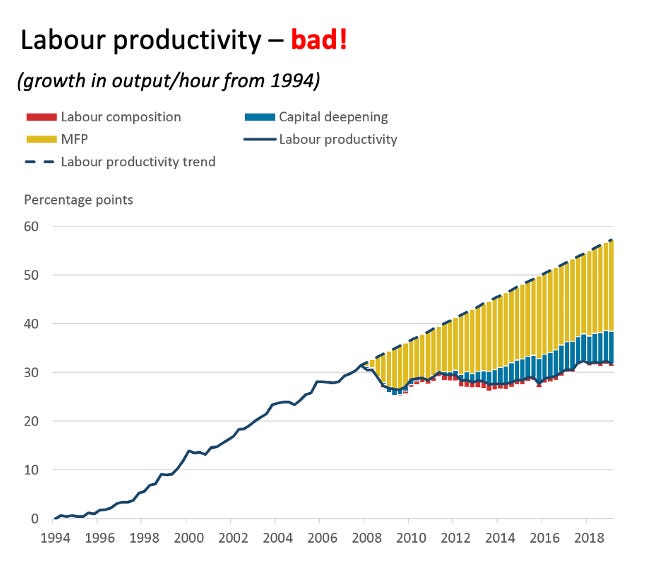
The Office for National Statistics has in the last month revised its productivity calculations. According to BBC Radio 4’s More or Less programme (23 Sept 2026), the result of the recalculation is that while the UK’s productivity annual increase dropped from roughly 2% to 1.3% after the financial crisis of 2008, this is a better result than a drop to 0.7% which the previous methods had suggested had happened. As a result, the UK is no longer considered an international outlier and Chris Giles of the Financial Times confessed that this brings into question the validity of arguments that he and other commentators had advanced in articles during this period.
The reason the figures have changed is that the number of hours people are actually working is now believed to be less than previously thought. This is partly because, when surveying and failing to get a response, they assumed the numbers would not have changed from those given in the previous period. But, sometimes the reason for the “no response” was that the person was on holiday, i.e. not working at all.
But let’s think about this a bit more. Supposing two people work for the same company and on days they are working from home both take time out to pick up their children from school. The first person deducts this from their time-worked stats, the second doesn’t. If both achieve the same, the first person will be considered the more productive, even though the volume of output is the same.
Similarly, if a person works unpaid overtime to output more in the working day, they will not be considered as more productive on this measure. But if you measured productivity as output divided by the amount it cost to achieve it then you would get a very different productivity assessment.
So, depending on what you are looking to learn from a productivity stat, one way of measuring it might be more appropriate than another. But the notion that you could simply choose one measure and call it the official UK productivity seems misleading and unhelpful.
Even more so when you try to look at the productivity stat for all workers. If you look into how the productivity of a nurse is calculated, the calculation is extremely complex…but nevertheless, it has been someone’s job to come up with an algorithm so that a nurse’s productivity can be measured and successfully combined with productivity achieved in other disciplines.
At this point it seems to me the whole exercise resembles an attempt to bang a nail into a block of wood using a pack of butter. The objective is clear enough: you can make some initial progress towards your aim, but as time goes on it gets increasingly difficult to complete the exercise without some form of “necessary” cheating. Yet we are committing some very capable and subtle minds to exactly this endeavour. One wonders how one measures the productivity of their work[1]?
Moreover, the figures we are lamenting as being poor are not a reduction in productivity but a decline in productivity growth. As More or Less explained, a 2% increase in productivity (as was achieved for a prolonged period prior to 2008) means that productivity doubles every 35 years or so. Asking a similar question to one posed by Kate Raworth[2] when she quizzed economists on why we consider it viable for GBP to grow exponentially, one might ask whether doubling productivity every thirty-five years is a reasonable expectation, desirable or even possible? Sure, technology will drive some productivity growth, but what about the care sector? As the ONS notes: “while quantity output may be growing, the value of this growth, and therefore productivity, may be overstated if service quality is declining.”[3]
And yet, we are constantly told that the solution to Britain’s problems are stronger growth and greater productivity. And whilst I can see that these might deliver to this country (possibly unevenly) greater internationally-agreed entitlement to the world’s assets, these measures alone tell us nothing of the contribution we are making to those assets, be that positive or negative.
[1] More generally, one is essentially asking whether output should really be included in productivity figures if it turns out to be useless.
[2] See Doughnut Economics, published Penguin Books, 2022 edition, Chapter 7
[3] https://www.ons.gov.uk/economy/economicoutputandproductivity/publicservicesproductivity/methodologies/publicserviceproductivityadultsocialcaresourcesandmethods2019update